For many small and midsize businesses, the path from first quote to money in the bank is messier than it should be. Sales sends PDFs by email. Customers reply with suggested changes. Someone updates a spreadsheet. Finance retypes numbers into an invoicing tool. The CRM is often out of date, and nobody is quite sure what was agreed when a payment is late.
Artificial Intelligence and modern Business Technology now make it realistic for smaller firms to automate the entire quote-to-cash cycle, not just bits of it. By connecting your website, Mobile App, CRM, billing, and E-commerce Solutions, you can build AI-powered workflows that generate accurate quotes, track approvals, create contracts, issue invoices, and chase payments with far less manual effort.
This guide explains in clear business language what AI-powered quote-to-cash automation is, why it matters for Small Business Technology and Startup Growth, and how to design a practical approach that fits your current Software Solutions instead of forcing a complete rebuild.
What AI-powered quote-to-cash automation actually is
Quote-to-cash covers every step from a customer asking for a price to the money landing in your bank account. In many companies this journey passes through several systems and people.
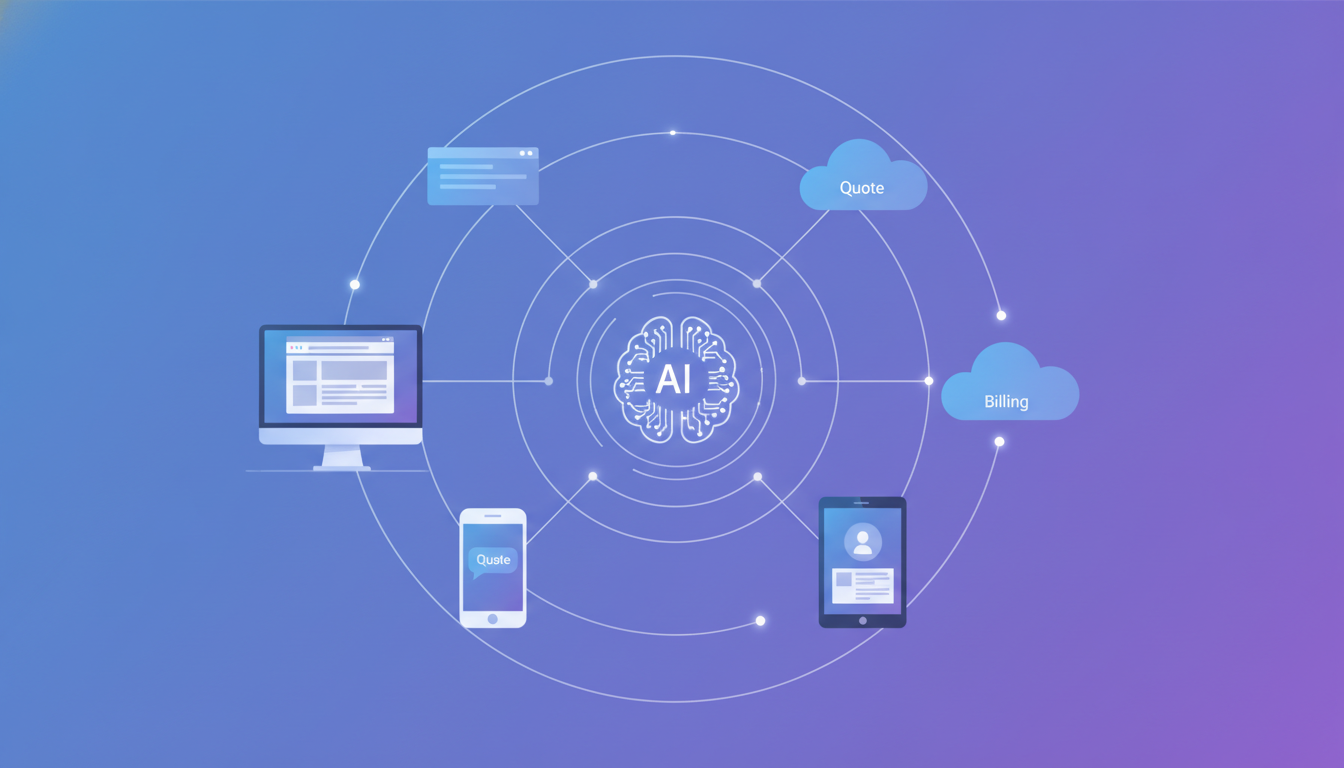
AI-powered quote-to-cash automation uses Artificial Intelligence, AI Automation, and Workflow Automation to connect these steps into a single flow:
- Your website or Mobile App captures a lead or quote request.
- The CRM records the opportunity and pulls in customer history.
- AI for Business suggests pricing, discounts, and product or service configurations based on rules and past deals.
- Quotes and contracts are generated automatically from approved templates.
- Once accepted, orders and projects are created in Enterprise Software or E-commerce Solutions.
- Invoices are issued, payments are tracked, and reminders are sent without retyping data.
Think of it as having a quiet digital coordinator for your revenue cycle. It keeps data consistent across Web Development, Mobile App Development, CRM, and billing tools, then uses Data Analytics and Artificial Intelligence to reduce errors and delays.
How AI-driven quote-to-cash differs from basic invoicing
Most small businesses already create invoices using accounting software or simple templates. The main differences with AI-powered quote-to-cash are:
- End-to-end, not just invoicing
The process starts with quoting and configuration, runs through approvals and contracts, then continues into billing and collections. - Connected systems instead of islands
Website, CRM, project tools, and Cloud Solutions share one version of the truth instead of separate spreadsheets. - Smart assistance rather than manual lookup
AI Automation suggests prices, terms, and next steps based on your rules and historical data, so staff do less copy-paste work. - Continuous improvement
Over time, Artificial Intelligence learns which quote patterns close faster, which discounts hurt margin, and where you lose days in the process.
If your tools already feel fragmented, Why technology is mandatory in today's business? is a useful backdrop, because quote-to-cash automation relies on treating Business Technology as shared infrastructure rather than disconnected apps.
Why quote-to-cash automation matters for small and midsize businesses
Cash flow is the lifeblood of any growing company. Small delays and minor errors across many deals add up to real money and time.
Typical quote-to-cash pain points
See if any of these sound familiar:
- Sales reps create quotes by copying old emails or spreadsheets, so formats and terms vary widely.
- Customers receive different prices from different people for similar work.
- Finance regularly finds mismatches between quotes, purchase orders, and invoices.
- Projects start before contracts are signed because the paperwork lags behind.
- Invoices go out late or with mistakes, which slows payment and damages trust.
- Nobody can clearly see pipeline value, booked revenue, and cash collection in one place.
These patterns drain Business Productivity, create write-offs, and lead to awkward conversations with customers. They also make Digital Transformation harder because your CRM, E-commerce Solutions, and accounting tools are out of sync.
Business reasons to invest in AI-powered quote-to-cash
A structured, AI-supported quote-to-cash process supports several goals:
- Faster cash collection
Cleaner handoffs from quote to invoice reduce delays. Customers receive accurate bills sooner, and automated reminders help them pay on time. - Higher Business Efficiency
Staff spend less time retyping data and chasing status updates, and more time selling or serving customers. - Better Customer Experience
Quotes, contracts, and invoices match exactly. Customers see clear pricing, terms, and progress, which builds trust. - Improved margin control
AI for Business can flag discount patterns, unprofitable deal structures, and scope creep earlier. - Stronger Digital Strategy
Leadership gets reliable numbers on pipeline, bookings, and collections, which makes planning and Business Innovation more grounded.
Core components of AI-powered quote-to-cash automation
You do not need to replace every system to improve your revenue cycle. Think in simple building blocks across your current Software Solutions.
1. Integrated lead and quote capture on web and mobile
The quote-to-cash journey often starts on your website or Mobile App.
Useful elements include:
- Quote request forms that send data straight into your CRM.
- Simple product or service configurators that guide customers through options.
- Pricing calculators that provide indicative budgets while recording inputs.
- Online scheduling for sales calls or demos tied to a specific opportunity.
The goal is to avoid “dead-end forms” whose details are manually re-entered later. Data from Web Development and Mobile App Development should create or update records in your CRM automatically so AI for Business can work with complete information.
2. Central CRM as the revenue system of record
Your CRM, or another central Enterprise Software tool, should hold the definitive view of:
- Accounts and contacts.
- Opportunities and deal stages.
- Quote versions and approvals.
- Final prices, terms, and contracted services or products.
AI Automation can then use this data to:
- Suggest cross-sell or upsell items based on deal type.
- Recommend discount ranges within your Digital Strategy and rules.
- Flag deals that look risky, for example heavy customisation with low margin.
Without a reliable CRM spine, quote-to-cash automation becomes a patchwork of partial integrations.
3. Guided quote and proposal creation
AI-powered quote tools sit on top of your product catalog, price lists, and service packages. In practice they can:
- Pull customer details and history from CRM.
- Ask a few structured questions about scope, timing, and priorities.
- Generate a draft quote with recommended options, add-ons, and pricing.
- Apply approval rules, for example manager sign-off above certain discount levels.
- Produce professionally formatted proposals or order forms.
This guided approach reduces errors, keeps pricing consistent, and shortens the time from enquiry to quote, which supports Startup Growth.
4. Contract and order automation
Once a quote is accepted, many businesses still spend hours turning it into contracts and orders. AI-powered contract generation and Workflow Automation can:
- Merge quote details into standard contract templates.
- Adjust clauses based on deal size, region, or regulatory needs.
- Route documents for e-signature on web or mobile.
- Create orders or projects in your E-commerce Solutions, ticketing tools, or project management systems.
The key is to keep customer, quote, contract, and order data aligned so nobody has to reconcile them later.
5. Billing, payment, and collections automation
Billing and collections are where quote-to-cash turns into actual cash. AI Automation and Business Process Optimization can support by:
- Creating invoices automatically when contracts are signed, milestones are reached, or subscriptions renew.
- Connecting to payment gateways inside your website or Mobile App for quick payment.
- Sending clear, timed reminders before and after due dates.
- Prioritising collections follow-up based on amount, customer history, and risk.
- Reconciling payments in your accounting or Cloud Solutions.
For businesses with subscriptions or usage-based pricing on SaaS Solutions, this layer is especially important. It keeps recurring billing accurate and transparent for both sides.
6. Analytics and continuous improvement
Data Analytics across the entire quote-to-cash flow help you see:
- Average time from lead to quote, quote to contract, and contract to cash.
- Approval bottlenecks and rework hotspots.
- Deals with persistent scope creep or discount pressure.
- Common invoice disputes and their root causes.
Artificial Intelligence can then surface patterns, such as specific products that trigger delays, regions with slower collections, or sales teams whose quotes convert faster. These insights guide Business Automation tweaks, staff training, and Digital Innovation.
How quote-to-cash automation fits into your Business Technology stack
Many leaders worry that improving quote-to-cash means replacing their CRM, accounting system, or E-commerce Solutions. In reality, AI-powered automation usually sits across existing Software Solutions.
A simple three-layer quote-to-cash architecture
You can picture your environment like this:
- Interaction layer: website, Mobile App, sales reps, customer portals, and support teams that interact with customers.
- Process and data layer: CRM, product catalogs, pricing rules, contract templates, and Data Analytics, often hosted in Cloud Computing platforms.
- Execution layer: billing and accounting tools, payment gateways, project systems, and E-commerce Solutions where orders and invoices live.
AI Automation sits in the middle layer, connecting data and applying rules across the journey. Custom Software Development can bridge gaps between tools so information flows without constant manual work.
Typical technology routes for SMBs
Small and midsize companies usually reach AI-powered quote-to-cash via one of these paths:
- Extending existing CRM and accounting tools
Many CRM and billing platforms have quote, contract, and automated invoicing features. Turning these on, tidying data, and adding simple AI for Business modules is often the fastest step. - Adopting a dedicated quote-to-cash solution
Some SaaS Solutions specialise in CPQ (configure-price-quote), contracts, and billing. They integrate with CRM and accounting and suit companies with complex pricing or product structures. - Building a lightweight workflow hub
Where processes are unique, a small workflow and integration hub built on Cloud Solutions can orchestrate steps across multiple tools and use AI Automation for pricing suggestions or risk scores.
The right route depends on your current stack, regulatory context, and growth plans. If your web presence still needs attention, Why does a business need a website these days? is a helpful companion, because many quote-to-cash journeys start on your website.
Practical examples of AI-powered quote-to-cash for small businesses
You do not need a large sales team to see value. Even a handful of deals per week can benefit from fewer errors and faster cycles.
Example 1: B2B services firm standardising quotes and contracts
A consulting firm sells fixed-fee and time-and-materials projects. Each consultant writes proposals in their own style. Contracts vary, and finance spends hours reconciling what the proposal said with what was billed.
They introduce an AI-supported quote tool tied to their CRM and templates. Now:
- Consultants answer a short checklist about scope, timing, and complexity.
- The tool suggests a suitable package, day rates, and likely effort range.
- Proposals are generated in a consistent format with standard clauses.
- Once accepted, the system creates a project, milestones, and billing schedule automatically.
Results include faster proposal turnaround, fewer scope misunderstandings, and invoices that match expectations, which improves Customer Experience and cash flow.
Example 2: SaaS startup automating subscriptions and renewals
A SaaS startup sells its software through both a self-service website and a small sales team. Manual processes create issues:
- Different customers receive slightly different terms for similar subscriptions.
- Renewal dates are tracked in spreadsheets.
- Occasional customers slip through without being invoiced correctly after a trial.
By connecting Web Development forms, CRM, subscription billing, and payment tools, then applying AI Automation, the startup:
- Creates standardised product tiers and add-ons in one catalog.
- Lets customers configure and sign up online with clear pricing.
- Automatically turns trials into paid plans when criteria are met.
- Generates renewal quotes and invoices on time with reminder workflows.
Finance now has a reliable view of monthly recurring revenue, and leadership can plan Startup Growth with more confidence.
Example 3: E-commerce brand adding B2B quoting to its website
An E-commerce retailer discovers more corporate buyers who want volume pricing and formal quotes. The original store is built for card payments only.
They add a quote request feature to product pages and integrate it with a simple CPQ tool and CRM. AI Automation helps by:
- Suggesting price breaks based on past deals and margin targets.
- Flagging unusually large orders for manager approval.
- Turning accepted quotes into orders and invoices automatically.
Corporate customers get the flexible quotes they need, while the retailer keeps control of pricing and avoids manual re-entry into the E-commerce Solutions and accounting tools.
Designing a quote-to-cash automation approach that fits your business
You do not have to automate everything at once. A staged, business-led approach reduces risk and builds internal trust.
Step 1: Clarify what you sell and how you price it today
Before thinking about Software Development, map your current offerings. For example:
- Standard products or packages with clear list prices.
- Services priced by time, scope, or value.
- Discount rules, bundles, and long-term agreements.
- Exceptions that cause confusion or frequent negotiation.
Identify which parts are suitable for standardisation and which truly need custom treatment. AI Automation works best on clear rules.
Step 2: Map your current quote-to-cash process
Next, walk through how a typical deal flows today:
- Where leads arrive, for example web, email, calls, referrals.
- How quotes are created, approved, and sent.
- How customers accept, sign, or request changes.
- How orders, projects, and invoices are generated.
- How payments are collected and disputes are handled.
Note every handoff between tools and teams. These are often the points where automation, Business Process Optimization, or new Software Solutions can help most.
Step 3: Choose a pilot segment
Trying to automate every possible deal type at once is a recipe for frustration. Pick a pilot scope such as:
- A specific product line with healthy volume.
- A country or region where processes are relatively simple.
- Deals under a certain value where you want fast turnaround.
This lets you prove value, refine rules, and gain staff confidence before expanding.
Step 4: Decide on tools and Technology Consulting support
Depending on your starting point, options include:
- Enabling quoting, contract, or subscription modules within your CRM or accounting system.
- Adopting a CPQ or billing SaaS solution that integrates with your existing stack.
- Working with a Technology Consulting partner to design a lightweight workflow hub using Cloud Computing and Custom Software Development.
Prioritise tools that business users can configure without constant developer help. Quote-to-cash rules change often as pricing and offers evolve.
Step 5: Define pricing and approval rules clearly
Technology is only as good as the rules behind it. For your pilot, document:
- List prices and allowed discount ranges for each item or package.
- Common bundles and standard options like support tiers.
- Which exceptions need manager or finance approval.
- Contract templates matched to deal types and geographies.
Artificial Intelligence can then suggest configurations and highlight exceptions instead of guessing in a vacuum.
Step 6: Automate a thin slice of the process
For your pilot, aim to automate one clean path from quote to invoice, such as:
- Lead captured on website and created in CRM.
- Salesperson uses guided quote builder with AI suggestions.
- Customer accepts quote via e-signature.
- System creates an order and first invoice in billing software.
- Customer pays using a link in email or portal.
Keep the path narrow at first. Parallel manual processes can handle complex edge cases while you learn.
Step 7: Measure, refine, and expand
After a few months, review:
- Average cycle time from quote to cash before and after automation.
- Error rates in quotes and invoices.
- Discount patterns and margin by deal type.
- Customer feedback on the buying and billing experience.
Adjust rules, templates, and workflows based on real data. Once the pilot is stable, bring more products, regions, or contract types into the automated flow as part of your ongoing Digital Transformation.
Business benefits beyond speed
Faster cash collection is the headline benefit, but AI-powered quote-to-cash also supports broader Business Innovation and Digital Strategy.
1. Cleaner data for better decisions
When quotes, contracts, and invoices share consistent data, leadership can trust reports on:
- Pipeline quality versus win rates.
- Revenue by product, segment, or region.
- Impact of discount policies on margin.
- Churn and expansion patterns for recurring revenue.
This makes it easier to test new pricing models, subscription offers, or E-commerce Solutions features.
2. Stronger collaboration across sales, finance, and operations
Quote-to-cash automation creates a shared view of what has been sold and promised. That helps:
- Sales avoid overselling capacity.
- Operations plan staffing and delivery more accurately.
- Finance manage revenue recognition and cash forecasts.
Disputes about “what was agreed” become rarer, because everyone is looking at the same records.
3. Better customer trust and lifetime value
Customers notice when a company is organised. Accurate, timely quotes and invoices, clear terms, and quick responses to questions all help:
- Reduce friction in renewals and upsells.
- Encourage referrals and positive reviews.
- Differentiate you from competitors with clunky processes.
This aligns closely with your marketing efforts and topics like Why digital marketing is important?, because strong campaigns convert better when the buying experience is smooth.
4. Foundations for future pricing and product experiments
Once your revenue processes run on structured data, it becomes much easier to trial:
- New subscription tiers or bundles.
- Usage-based or outcome-based pricing.
- Self-service upgrades inside your website or Mobile App.
AI for Business can model impacts and spot patterns, helping you innovate without losing control of margin or billing accuracy.
Common misconceptions about AI-powered quote-to-cash
Several beliefs keep smaller firms from modernising their revenue processes.
“We are too small for quote-to-cash tools”
Even a small business with a few salespeople can benefit from consistent, automated quotes and invoices. The scale of tools and Custom Software Development can match your size, but the underlying ideas apply widely.
“Our data is too messy for automation”
Most companies have imperfect data. A quote-to-cash project can actually help clean things up, because it forces you to tidy product catalogs, pricing rules, and customer records. You can start with one clean area rather than waiting for perfection.
“AI will replace our sales and finance teams”
Artificial Intelligence can suggest prices, highlight risky deals, and schedule reminders, but it does not know your strategic priorities or relationship history. People still negotiate, make judgment calls, and handle exceptions. AI Automation simply takes repetitive steps off their plate.
“Automation will make us inflexible with customers”
The risk is real if you hard-code everything. A better approach is to design default automated paths for common deals, then allow controlled exceptions with clear approvals. This preserves flexibility without descending into chaos.
Common mistakes to avoid
Quote-to-cash initiatives can stall if they follow technology trends instead of business reality.
Mistake 1: Automating a broken process as-is
If your current process is confusing, faster automation will only spread mistakes more quickly.
Better approach: Simplify and standardise key steps first, then add Business Automation. Use the project as a chance to cut unused pricing options and outdated templates.
Mistake 2: Ignoring finance and legal teams
Sales-led automation efforts can forget about revenue recognition rules, tax, and contract risk.
Better approach: Involve finance and legal early. Agree which clauses and billing rules are non-negotiable and encode them into templates and AI Automation rules.
Mistake 3: Focusing only on technology features
Shiny quote builders and dashboards are attractive, but adoption fails if they do not fit day-to-day work.
Better approach: Spend time with sales, account management, and finance staff. Map their tasks, frustrations, and goals. Design workflows that match how they work today with gradual improvements.
Mistake 4: Overcomplicating pricing models too soon
AI-powered tools make it tempting to introduce complex tiers, bundling, or usage metrics.
Better approach: Start with pricing structures that customers understand and your team can explain. Add complexity only when there is clear demand and internal capability.
Key metrics for evaluating quote-to-cash automation
To see if your initiative is delivering value, track a mix of speed, quality, financial, and adoption metrics.
Speed and process metrics
- Average time from qualified lead to first quote.
- Average time from quote acceptance to first invoice.
- Number of manual touches per deal in the pilot scope.
- Cycle time reductions after automation.
Quality and accuracy metrics
- Quote error rate detected before and after sending to customers.
- Invoice dispute rate and common reasons.
- Frequency of reissued invoices or credit notes related to process errors.
Financial and cash metrics
- Days sales outstanding (DSO) for automated deals versus legacy deals.
- Discount levels by product and segment.
- Gross margin trends after standardising pricing and approvals.
Adoption and experience metrics
- Percentage of eligible deals using the automated process.
- User satisfaction among sales and finance staff.
- Customer feedback on quoting and billing clarity.
Over time, these metrics help you refine AI models, Workflow Automation, and Business Process Optimization, and show stakeholders the value of further Digital Transformation in revenue operations.
Future Technology Trends in AI-powered quote-to-cash
Technology Trends in quote-to-cash are moving quickly, but some directions are already visible for Small Business Technology.
Conversational revenue assistants
Sales and finance teams will increasingly ask natural questions like “Show me all quotes awaiting approval above a certain margin impact” or “Which deals are most likely to slip this month” and receive clear answers based on live Data Analytics.
Dynamic pricing and configuration
AI for Business will increasingly support dynamic price recommendations based on demand, capacity, and competitor context. For some sectors, quotes will be adjusted in near real time within approved ranges.
Tighter integration with customer self-service
Customers will expect to generate quotes, adjust configurations, sign contracts, and manage billing directly through websites and Mobile Apps. Behind the scenes, AI Automation will keep data aligned and flag unusual patterns for review.
Automated compliance and audit trails
As regulations on billing and contracts increase, quote-to-cash tools will automatically produce audit-ready histories of approvals, clause choices, and pricing justifications, reducing manual compliance work for finance and legal teams.
Summary: Treat quote-to-cash as a strategic business process, not just admin
Your quote-to-cash process is how intent turns into revenue. If it relies on scattered spreadsheets, inconsistent emails, and manual re-entry between systems, you leave money on the table and create avoidable friction for customers and staff.
AI-powered quote-to-cash automation offers a practical way forward. By connecting web and mobile touchpoints, CRM, contracts, billing, and payments, then adding Artificial Intelligence and Workflow Automation where they add clear value, you can shorten cycles, cut errors, and improve Business Efficiency without losing necessary flexibility.
You do not need enterprise budgets to start. Begin with one product line or segment, map the journey from quote to cash, standardise pricing and templates, and automate a thin slice from enquiry to invoice. Use Data Analytics to learn what works, then expand step by step as trust and results grow.
If you are planning new Software Development, Custom Software Development, Web Development, Mobile App Development, AI for Business initiatives, or broader Business Automation and Digital Strategy work, it is worth including quote-to-cash in the discussion. A short, focused conversation with an experienced Technology Consulting partner can help you design an AI-powered revenue process that fits your size, sector, and growth ambitions, and turns every accepted quote into cash more quickly and reliably.